

Human Potential in the Age of AI
A widely held belief in the context of the proliferation of artificial intelligence concerns the easing of work and the simplification of employees’ tasks through AI use. A recent study conducted by University of California, Berkeley surprisingly challenges this line of reasoning.
The study, carried out over a period of eight months, shows that AI tools do not reduce human labor; on the contrary, they intensify it. Employees included in the study increased their work pace, were assigned more and more tasks, and worked overtime. Participants reported that their workload had grown to levels that were difficult to sustain, generating symptoms of chronic fatigue and burnout. Overall, after an initial rise in productivity following the introduction of AI tools, a decline in work quality ensued, with some employees choosing to look for new jobs.
At the same time, Cengage Group, a global leader in digital educational platforms, published a study according to which, in 2025, only 30% of the USA university graduates managed to find employment in the field for which they had trained. More than half of the graduates stated that they felt unprepared for the labor market. This shows that the demand for degrees in large companies is becoming increasingly volatile, one of the reasons being the replacement of entry-level employees with AI agents and other tools based on artificial intelligence.
Not only the academic or economic environment, but humanity as a whole is struggling to understand the impact of AI and to provide answers to a wide range of ethical concerns or issues related to the abuse of intellectual property rights. The irresponsible use of AI has already made using the internet a far more unpleasant and insecure experience for many of us. AI hallucinations may be the subject of jokes, but in reality, they can create vulnerabilities in the major systems upon which both our daily comfort and security depend.
In this context, the questions seem to outnumber the answers, at least for now. Here is a fundamental question: what remains irreducibly human in a world of predictive algorithms?
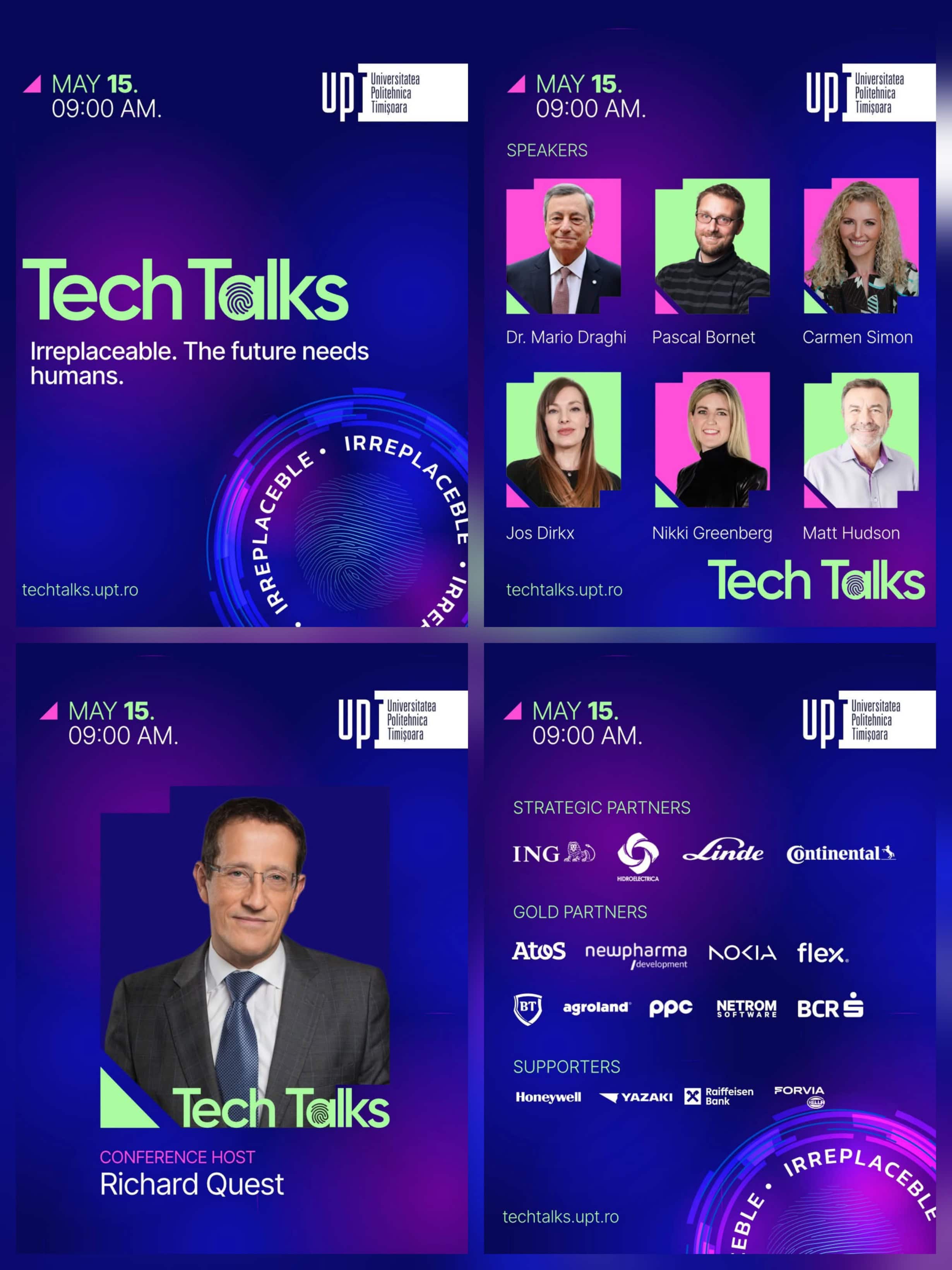
This is the question launched by Universitatea Politehnică Timișoara as the theme of Tech Talks by UPT, returning in 2026 with the topic “Irreplaceable. The Future Needs Humans.” This year’s edition aims to be a manifesto about the role of human beings in a future dominated by technology and about the balance between innovation, responsibility, and humanity. Tech Talks 2026 also marks a special moment and a premiere for Eastern Europe. Mario Draghi, the influential voice in the global economy, will arrive in Timișoara on May 15, 2026, to debate—together with other global opinion leaders—topics such as the impact of AI, as well as ethics and human potential in the new digital era.
As a UPT alumnus, I welcome this initiative and am confident that the debate in Timișoara will contribute valuable ideas toward shaping a better future. I believe that dialogue among people, a generator of progress, demonstrates the power of humanity.
Article published by Stirile Transilvaniei – https://stiriletransilvaniei.eu/2026/03/01/potentialul-uman-in-era-ia/